 eBook
eBook
WHITE PAPER
MAXIMIZING THE POTENTIAL OF YOUR CONTINGENT WORKFORCE
Best Practices for a First-Generation Managed Service Provider (MSP) Program
The contingent workforce has become an essential part of the majority of organizations, consisting of skilled freelancers, contractors, gig workers, and temporary staff. Managing this extended workforce can be challenging, prompting companies to rely on Managed Service Providers (MSPs). This white paper explores key considerations for engaging a first-generation MSP, addressing benefits, challenges, and effective strategies.
TABLE OF CONTENTS
*Click title to jump to section
INTRODUCTION
The contingent workforce is here to stay. Today, skilled contingent workers—freelancers, independent contractors, gig workers, and temporary staff—make up an estimated 50% of the labor force for the majority of organizations. To effectively manage this growing extended workforce, an increasing number of companies are turning to Managed Service Providers (MSPs) for support. This is illustrated in SIA’s recent Workforce Buyer Survey, which reports that 58% of companies with more than 1,000 employees adopted an external MSP in 2025, up from 40% in 2009.
Originally developed to manage security, networking, applications, and infrastructure services in the IT community, MSPs quickly proved valuable by streamlining processes and creating meaningful visibility, leading to their adoption in many other areas, including contingent workforce management. Today, MSPs are strategic partners to large and mid-size companies in a range of industries, including pharmaceutical, healthcare, retail, technology, entertainment, and construction, among others.
MSPs in the contingent labor space function as a third-party workforce management solution to oversee a network of approved staffing suppliers. MSPs become responsible for staffing supplier operations and contracts, procurement activities, compliance and risk mitigation, staff augmentation, direct sourcing initiatives, SOW management, services procurement strategies, workforce intelligence/analytics, and other related areas.
Companies considering an MSP partnership must carefully evaluate the organization’s contingent workforce program, identify key stakeholders, assess technology systems, and analyze costs. A phased approach to implementing a first-generation MSP is recommended, and success should be monitored through defined metrics and regular communication. A well-executed MSP implementation brings significant benefits to organizations, including increased productivity, reduced costs, improved efficiency, improved compliance, and enhanced visibility of the temporary workforce that can drive actionable business insights.
This white paper explores the key considerations involved in engaging a first-generation MSP, including the benefits, challenges, and best practices for selecting and implementing an MSP that aligns with a company’s unique contingent workforce needs.
THE ROLE OF AN MSP IN MANAGING A CONTINGENT WORKFORCE
Contingent workers offer flexibility and responsiveness to business operations, enabling companies to capitalize on market opportunities and quickly access difficult-to-source skills. However, an unmanaged contingent workforce can drain resources, waste time and money, and create risk. To avoid these issues and optimize the benefits of a contingent workforce, it is crucial to engage an MSP to manage and streamline contingent workforce management effectively and efficiently.
Companies turn to MSPs to address three key challenges that often come with growing contingent labor demands: risk mitigation, cost containment, and data transparency. Unlike standard employee practices, contingent workers are sourced, onboarded, supervised, paid, and offboarded in different ways by a multitude of suppliers, often leading to a lack of enterprise oversight, visibility, consistency, worker misclassification, higher costs, and co-employment risks.

To manage these risks, organizations require a more comprehensive approach to contingent workforce management that combines technology and a dedicated team of experts. Modern MSPs offer this combined expertise and technology, enabling companies to achieve greater flexibility within the program while reducing costs through contractual and operational best practices.
By leveraging the full breadth of a cutting-edge MSP’s capabilities, organizations unlock total talent management that streamlines processes and offers data, insights, and analytics on their contingent spend. This enables improved, centralized, and consistent oversight that was previously challenging to achieve.
CONSIDERATIONS WHEN ENGAGING AN MSP
Organizations seeking to engage a Managed Service Provider must carefully evaluate the size and maturity of their contingent workforce program and assess their specific needs for managing that workforce. Because MSPs are a customizable solution, companies should determine which processes or components they need managed and to what extent – common populations managed in an MSP program include employer of record payrolling, supplier staff augmentation, direct sourcing temporary workers, and independent contractors. While each of those groups is considered ‘contingent workers’, each has its own nuances and complexities to consider, both strategically and operationally.
By identifying their unique requirements, companies can engage an MSP that has the requisite expertise and can deliver a program that is well-aligned with its culture and goals. Identifying program goals — such as achieving defined cost savings, increasing utilization of client-identified workers, or setting diversity targets — will also help companies choose the right MSP.
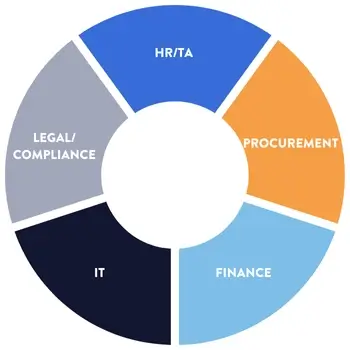
Collaboration is crucial. Consider these key areas when creating a steering committee:
STAKEHOLDERS
Collaboration is crucial. Before going to market, organizations should establish key operational and leadership stakeholders in the current temporary resource process. Ensuring cross-company representation from senior sponsors that will proactively support and promote the program is imperative to creating a well-adopted program.
Consider these key areas when creating a steering committee:
- Human Resources/Talent Acquisition
- Procurement
- Finance
- IT
- Legal/Compliance
REPORTING
Many companies will not yet have comprehensive or reliable reporting available when going to market for an MSP. However, through the sources available on the contingent workforce’s current state, it is beneficial to gather existing reports that provide insights into markets, job titles, bill rates, length of assignment, and contingent worker types. Providing potential MSPs with a list of the top ten positions with their job descriptions, and preferred staffing suppliers (along with key commercial terms such as markups and temp-to-perm conversion fees) will prove beneficial.
INTERNAL RESOURCES
Analyzing the internal management of the contingent workforce is another important exercise in preparing to implement an MSP. Companies should consider HR, Finance, and Management resource allocations to ensure organizational input and best practices are infused into the MSP, including:
- HR: headcount allocations, identity management, diversity targets, temp-to-perm conversion strategies, rogue spend
- Finance: budget approvals, purchase order management, invoice approvals and processing, spend controls, and visibility
- Worker Management: provisioning, performance feedback and management, management best practices, timesheet approvals
TECHNOLOGY
Effective implementation of an MSP in a scalable, efficient, and turnkey manner requires the strategic use of technology. To achieve this, organizations need to assess their existing internal and external systems currently used throughout the process of sourcing, matching, engaging, onboarding, and paying Temporary workers. These may include:
- Applicant Tracking System (ATS)
- Vendor Management System (VMS)
- Freelance Management System (FMS)
- Human Resources Information System (HRIS)
- Candidate Relationship Management (CRM – Talent Community)
- Accounting/Finance
- Contract System
External technologies like a VMS will power the MSP requisition process and provide robust analytics. The right VMS will pair with the internal technology stack to facilitate a smoother implementation process and stakeholder and supplier adoption.
Once an organization thoroughly assesses its contingent workforce, suppliers, technology, and costs, the team can go to market, understanding precisely what its need is, and select an MSP that best aligns with those needs, enabling it to effectively manage its contingent workforce while minimizing costs and maximizing value.
THE LIFE CYCLE OF A FIRST-GENERATION MSP
A phased approach is optimal when installing an MSP. This type of model enables organizations to design, implement, and operationalize functions that are not currently managed by an MSP efficiently and effectively. This approach also allows for sufficient time to identify and partner with the right technology and service providers, as well as build trust within the organization before further expanding the program into new areas.
The best MSPs leverage strategic solutions for change management and ensure a collaborative and process-driven transition to a future state. It is important to note that the time and resources required for each phase may vary from client to client, depending on the scope and volume of each program. While a phased rollout will vary depending on an organization’s needs, a typical process may look like this:
PHASE 1:
During this phase, MSPs ensure a seamless implementation and transition of supplier management and EOR payrolling. The focus is on change management, manager/supplier/ worker orientations, onboarding, maximizing compliance, VMS configuration, analytics, and reporting.
PHASE 2:
Direct Sourcing, curation of a talent community, and independent contractor compliance often follow in Phase 2. At this stage, the focus is on layering Direct Sourcing via an ATS and/or talent community technology to successfully curate active and passive job seekers.
PHASE 3:
MSPs typically begin Statement of Work (SOW) planning, which involves reviewing providers, configuring Vendor Management Systems (VMS), negotiating contracts, transitioning, and making payments. The team accomplishes all of this while maintaining an eye for further streamlining the process and enhancing visibility. This could include the expansion of established EOR payrolling, IC compliance, or Direct Sourcing programs.
ENSURING SUCCESS
To monitor the program’s success, companies work with MSPs to define SLAs/KPIs. These metrics are related to program management, Standard Operating Procedures (SOPs), and other measurable areas to monitor all program success points. They may include:
- Governance and responsibility for ensuring program workflows/efficiencies
- Program metrics and reporting
- Regular business summaries
- Quarterly business review sessions
- Compliance requirements (pre-employment screening, client-specific document execution, etc.)
- Demonstrating continuous Program Improvement, added value, and savings.
More specific KPIs may include:
Regular communication and review meetings are essential for successful MSP programs. Companies should expect to have periodic Business Reviews and status meetings with stakeholders. These are typically hosted one month post-program launch, followed by quarterly and annual reviews as the program matures. The discussions are informed by surveys and VMS platform analytics and summarize program development, performance, and learnings, and offer recommendations. Open dialogue is essential during these reviews to facilitate continuous program improvement and client satisfaction.
Typically, businesses will work with an Implementation Team until go-live. Once the program is up and running, the dedicated MSP team steps in to support the daily program, maintenance, escalations, and administration. Executive leadership of the MSP serves as a consistent guide, overseeing the program closely to ensure successful enhanced partnership during implementation and beyond.
CONCLUSION
Temporary workers have become an integral part of the modern workforce, but managing them can be complex and challenging. Organizations often struggle to effectively manage multiple suppliers, VMS, and payroll systems while maintaining compliance and cost control. However, an MSP can provide an innovative and efficient solution to these challenges. An MSP can streamline the hiring process, simplify vendor management, ensure compliance with regulations, and optimize cost management.
By approaching a first-generation MSP in phases, organizations can ensure the program is scalable and customized to their unique contingent needs. Effectively installed MSPs will be designed with considerations for technology and the existing workforce and will clearly define KPIs/SLAs. The advanced metrics and robust reports provided by forward-thinking MSP partners will offer insight into a company’s extended workforce beyond existing reporting. Key to implementation is change management, as MSP partners build trust in the process and gain key stakeholder buy-in. Finally, as an organization operationalizes its MSP, it should expect regular collaboration as the program transitions to a steady state.
*The information provided on this fact sheet does not, and is not intended to, constitute legal advice; instead, all information, content, and materials available here are for general informational purposes only.
LET'S TALK ABOUT THE FUTURE OF WORK.
Complete the form below and we’ll get in touch within 24 hours.