GOVERNANCE – A FRESH TAKE FOR CONTINGENT WORKFORCE LEADERS
WATCH NOW
Atrium’s workforce experts and our special guest, Chris Radvansky of RAD Consultants, discuss building contingent workforce program governance that works, grounded in real solutions and actionable strategies.
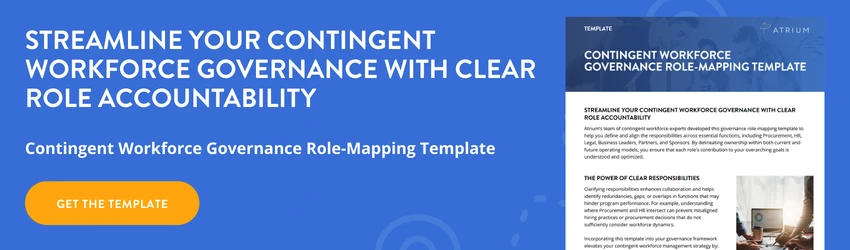
ACCOMPANYING ROLE MAPPING TEMPLATE
TRANSCRIPT
[Brad Martin: 00:00.3]
All right. Well, good morning. I’d like to welcome everyone to today’s webinar brought to you by Atrium. A bit of housekeeping as we get started. First, today’s webinar is being recorded, and it will be provided to you by email after. In addition to the webinar recording, all attendees today are also going to receive a role mapping template that Atrium has put together for you. Now, this template is an awesome resource for determining roles and responsibilities when establishing governance in your program. So please do leverage this resource. It’s free, you’ll receive it. I’m going to plug it multiple times throughout the webinar day. And lastly, we will have a question-and-answer segment at the tail end of the webinar, so if you have any questions about topics we covered along the way, please don’t hesitate to ask them. Put them in the chat, we’ll collect them, and we will loop back to them at the end of the webinar.
So, with the housekeeping out of the way, let’s get started. The topic of today’s webinar is contingent workforce governance. So why does this matter? Well, strong contingent workforce governance is exactly what separates high performing programs from reactive crisis driven operations.
When your governance is weak, organizations experience things like fragmented processes, unclear accountability, inefficiencies and compliance risk, but the good news is that proven, achievable governance frameworks exist, and they exist to fix these issues. And that’s exactly what we’re going to discuss on the webinar today.
We’ve got some fantastic panelists joining us to dig into this topic. First, my name’s Brad Martin and I will be your emcee today. I’m Atrium’s Chief Revenue Officer and I have nearly 25 years of experience in contingent workforce management, staffing and workforce tech.
But more importantly, I’m joined by two wonderful industry experts, Cindy Baker-Bailey and Chris Radvansky. Cindy, Chris, welcome to the webinar.
[Chris Radvansky: 01:50.7]
Thank you, Brad.
[Brad Martin: 01:53.0]
Cindy is Vice President of Global Workforce Solutions at Atrium with over 20 years of experience leading global and total talent programs. She has led scaled programs, worked closely with clients to build governance models that drive transparency, performance, and ultimately long-term success. So welcome, Cindy.
And we’re also joined by Chris Radvansky, who is the owner of RAD Consultants. By the way, Chris, awesome name for your company. Love it, if I haven’t mentioned that to you before. RAD Consultants is a data analytics and artificial intelligence (AI) consultancy that helps companies in the contingent workforce space, get better control of their data, visibility around their data.
RAD is also building custom AI workflows so that people in HR can spend more time driving value through initiatives, less time on things like data movement and repetitive tasks. So welcome to the call, Chris, as well.
When it comes to the topics we’re going to discuss today around governance, given their expertise, given their experience and real-world application of the things we’re going to talk about, these are the folks you want in the room with you. These are the people you want to talk with. So we’re excited to have these panelists on the call today.
We have, broken the webinar down into four main discussion areas. These are first, governance models at work. Second, data and motion, so how it behaves and why it matters. Third, stakeholder buy in, so tactics for driving behavioral change. And then last, how to align all this and how to actually take action from where you are today to where you may be going. So, with all that said, let’s jump into the first section, which is governance models that work.
Cindy, perhaps we’ll start with you today to get the conversation going. How would you clearly define and align the roles of procurement, HR, legal, business leaders, and vendors to avoid overlap and gaps?
[Cindy Baker-Bailey: 03:50.2]
Sure. Well, firstly, thank you for having me, Brad. Excited to be here and thanks for the folks joining the webinar today. So, as it relates to that question, first, I think for me the starting point is always alignment on why governance exists in the first place. Before we talk about roles, everyone needs to really understand the shared objectives and value of having a framework. And we anchor that governance on four key pillars: cost, quality, efficiency and risk. Those pillars don’t change. But what does change is how different stakeholders prioritize them.
I’ll give you an example. When you think about, procurement as one of your kind of functional key leads, they generally lean into cost, right? They want to know what is the ROI of this program. And then you think about HR and talent acquisition and they’re more concerned and their priority is the talent and the quality of the contingent workforce. And then of course, legal. Compliance and risk is their priority.
None of it is wrong. It just needs to be aligned. Which is why it’s really important to have a strong governance model that brings the right people to the table from the very start. So, you want to make sure that you’re including, as I mentioned, procurement, HR, TA, legal, technology is always good to have as well. And then of course, if it’s in house, your program office, team leadership or your Managed Service Provider (MSP) leadership. And then I also like to include business unit stakeholders, depending on where we are in terms of our governance framework and what initiative we’re trying to sort of implement. You know, it is good to have folks have a stake in the game.
So I think about for example, Statement of Work (SOW) services. SOW is generally, managed by technology, for example, in one division where they use a lot of the SOW vendors, they work with procurement directly, but perhaps they don’t have sort of a structured governance model. And so what we want to do is bring that into the program and we want to bring those business unit leaders into our discussions and talk about what we can do to help and support them in inclusion of SOW.
So again, depending on whatever initiative it is that you’re working on, that those are the leaders that you should bring into your governance framework. And once that’s established, once you have the key stakeholders that you want to include, a role-mapping, what I like to call sort of a RACI style matrix is created, and we’ll talk a lot about that today in this webinar. But just to kind of kick this off, you really want to start off a role-mapping exercise that outlines who are the decision makers, who have the decision rights, who’s executing versus who has oversight responsibilities. And then of course, any governance framework should have some escalation paths as well.
So, by having all of that, it eliminates, to your point, what are some of the gaps? I think it eliminates the overlap, the gaps, the duplicate approvals that might happen throughout your contingent workforce program. And most importantly, it drives stakeholder buy-in. When you start including others within this framework, it really sort of drives that again, they have a stake in the game and hopefully, ultimately it leads to a more effective, program outcome. So that’s kind of how I’d handle that topic, Brad.
[Brad Martin: 07:21.4]
Yeah, you mentioned something interesting in there as well that was ROI and touched on that and how do you demonstrate the governance ROI to the different stakeholders? And it really requires translating those operational improvements into metrics that are tangible, that leaders can understand, like financial impact or risk avoidance and scalability. So, it’s really important to be able to demonstrate that in those ways.
Chris, what practical steps would you suggest organizations take to unify data workflows and systems through effective technology integrations?
[Chris Radvansky: 08:01.2]
Yeah, you said data and that’s kind of my bread and butter here, Brad, as you teed me up, and I appreciate you and Atrium bringing me on. In fact, this morning my 11 year old daughter asked me, well, Chris, or she doesn’t call me Chris, she calls me Dad. But she says, Dad, is it data or is it data?
And I say, well I kind of interchange both. It’s potato, potato. And then I asked later if they want some mashed potatoes for dinner. And yeah, but I’ll interchange both. But when it comes to governance and it comes to data, I’ll say data here, you need to start with good governance. If I’m going to jump into a program, I’m going to analyze. Where are we right now? Where do we want to go? It has to start with governance. Governance is really the table setting for a strong contingent labor program, right? And you think about a table setting, you got your plates, you got your glasses, you got all your different knives and forks and utensils. Maybe you have a salad knife, fork, whatever it might be. But if you don’t have a sturdy table and you start serving food, it’s going to be an absolute mess. And the way that we can engage and ensure that we have a very nice setup once the process starts moving along is you have some strong governance in place these days.
These days, I’m not going to blow anybody’s mind. It’s not going to be the first time you’ve heard it. Maybe you need to hear it a number of times before you maybe take action. Technology is critical. Technology does not mean 15 different spreadsheets across 15 different departments. Processes moving very disparately. We have no idea how one process operates versus the other. So that’s where you need to have some kind of a system. A lot of time that’s going to be a Vendor Management System (VMS), a Freelance Management System (FMS). Of course, you might be familiar with an Applicant Tracking System (ATS). All these different ways in which you have kind of a town square of sorts when it comes to this is what we do. This is where we all congregate when we need to get something done.
The thing is, businesses generally do two things, they either operate or they tell people that they’re operating. I think what I’ve seen historically as maybe one of the ways in which folks and programs cannot move to where they want to go, where that success, what that looks like, they can’t get there because they don’t communicate clearly enough and frequently enough. This is the new process that we just implemented, and therefore this is how you should be changing your processes so that we can capture all that, so that we can set the table appropriately and function efficiently. So, for me, Brad, it comes to data. But you can’t have strong data without strong governance. You just can’t do it.
[Brad Martin: 10:41.9]
Yeah, and it really does come down to what you said about foundation. Getting that foundation in place is critical. And only once you have that foundation in place, then you can really start to get into how the data behaves and you know, why governance is the lever, at the end of the day.
And that brings us into actually our second section here, which is data in motion.
Chris, I’m going to throw to you on this one. How does data move across platforms, vendors, teams, and what typically goes wrong when that data doesn’t align?
[Chris Radvansky: 11:10.1]
Yeah, it does start with communication. Like I said, you know, we need to market this new process, this new technology, these new systems, these new stakeholders, as Cindy had mentioned, we need to make sure that we understand who’s responsible for what, and then where to go if we need to escalate, things like that. So that’s very critical.
But when you think about a contingent workforce ecosystem, there are so many different players in place. And the story and the communication that you need to have to a supplier might be different to a background check company. Might be different to the workers themselves. Might be different to the hiring managers. Might be different of course to executive leadership, who you want to make sure you have on your side.
So when we talk about, well, what data, how do we move all these people, how do we get them engaged? It’s really starts with intake. We need to make sure that everybody knows this is how we are going to be receiving information. That could be anecdotal, narrative, feedback from leadership. It could be how a supplier wants to operate, which job categories or titles that they want to be able to support, or certain locations. of course. If the roles that they generally support are going to be in an office, which is going to be required from time to time, of course. But ultimately, if you don’t have that strong governance, you’re going to get garbage in, garbage out.
Or on the optimistic side, I like to say, quality input yields quality output, if you want to kind of put a nice positive spin on that one. But that’s just the fact of the matter is you can have all the governance in place, but if you don’t have the stakeholders that are leaning on those individuals that are saying, listen, this is how we’re doing things now and this is why we’re doing things.
You know, as Cindy was talking, one thing I wanted to mention about stakeholders is that you need to make sure that they have some skin in the game, and Cindy, you’d mentioned that. But make sure they also have the bandwidth. They need to recognize that if, depending upon their level of seniority, if they spend 10% of their time, 8% of their time, whatever it might be, but there needs to be something, especially in the early stages that says this person is responsible for this or accountable for this.
But they need to have the bandwidth and the skin in the game to make sure the program can really get off its feet. So, Brad, I would say, you know, I can go all different directions on this. I know we’re going to continue to talk, but I get excited about contingent workforce management, Brad. I’m sure you do as well.
[Brad Martin: 13:35.1]
Oh, absolutely, absolutely. So, Chris, as it relates to governance related data breakdowns, you can’t fix what you can’t identify, right? So, in your opinion, where do governance related data breakdowns most commonly occur and how can you identify and fix those?
[Chris Radvansky: 13:54.7]
I mean, it comes to a lack of clarity. You know, there’s times where you’re taught something and it may or may not stick, but then there’s times where if you know how to teach somebody else how to do something, then all of a sudden that sticks. And what needs to stick is strong governance.
And it’s not going to stick without proper policies in place, without proper exception processes, that are documented as well, thresholds. When it comes to those exceptions, how many times should we have those exceptions in place? And if you don’t have that all documented again, you can kind of start down the right path, but oh, what happens when these edge cases occur and these are occurring 20% of the time and there’s no answer for that? Well, people will start to divert and they’ll continue to divert and then of course the program breaks down. Then you find yourself in a situation where what we thought it was going to be a $25 million program and well, because we have all this divergence, it’s heck of a lot smaller now. That’s not okay. Because that really reduces your visibility, that reduces your ability to achieve the goals that started this initiative to begin with.
So, the lack of clarity is critical. And for me, again, I love visualizing data. When I can visualize data, whether it’s a pie chart, line chart, a tree map, you name it. And of course, nowadays we have natural language processing, so building custom chatbots specific to the data set that you’re analyzing, that doesn’t get started, that doesn’t launch at all without strong governance in place. And for me, I think no one’s out to get anybody. People just want to recognize like this is going to be the best way forward for everybody, right?
So, you’re going to have a different supplier mix, they’re going to be capable of filling certain roles in certain locations. But as long as we’re doing kind of an apples-to-apples comparison when it comes to our data, that’s really where you want to be.
[Brad Martin: 15:55.0]
Yeah. And when it comes to the governance structure in the program overall, you know, having consistent data standards is so critical and so important.
Can you speak a little bit to how taxonomy alignment and having consistent data standards really improves things like reporting accuracy or stakeholder trust and program performance?
[Chris Radvansky: 16:15.2]
Yeah, I hear taxonomy, Brad. And I think of, job title taxonomy. I think that a lot of people do. There’s departments, there’s job categories, there’s all different categories that you have out there that do require some level of taxonomy and control. But, I think most people’s minds go to job titles, I think, appropriately so. There are the SOC 2019, which is kind of the latest oversight body that says, okay, here’s all the different job titles.
Now, if you’re a contingent labor program and you say, okay, well, we should go ahead and adopt that standard, you’re going to open that up and you’re going to say, this doesn’t really apply to us, and we need to get a lot more granular. And well, we have so many different exceptions to that thing that, well, maybe we should start with something else. And that’s generally what I’ve seen. I think that something like that, you know, to get your taxonomy started, can all of a sudden shine a light on maybe, okay, you know what? We don’t have any sales roles within our program. We don’t have any, maybe clinical roles or light industrial roles. And maybe that’s something that we should engage with, and we can go back into that RACI and say, hey, who’s responsible and accountable for those types of roles that maybe we forgot when we got this whole thing started. So those kinds of standards are good to kind of shine a light on those, those blind spots that you didn’t recognize that you had.
But when we’re talking about job title taxonomy, again, you can look at your full time employee roles and understand what those are all. And you know, all of a sudden you’re going to say, wait a second, those are kind of wild west. So, what I’ve seen as something that I don’t like seeing very much is where you have a thousand different job titles, let’s say, 20 of them have been filled five times or less. And then you have 980 that are filled one or two times, right? So that’s that long tail. And what I was thinking about this is like, that’s more like a snake than an alligator of any kind, right?
So, if the entire program of job titles is just 111-12-1111111, then a person like me, I say, okay, let’s analyze your job titles. How are they performing? You know, who’s filling those roles? Whether you know, from a supplier perspective is, are you doing Employer of Record (EOR) activity? Maybe. Of course, if you engage with SOW, that’s something that we can maybe throw into the mix. But you can start reporting okay, well this job title, which was filled 60 times, good volume. Of course you can say, here’s the average bill rate, here’s the average pay rate, we understand supplier markups, here’s how long it’s taking to fill. Here’s how many resumes that we’re receiving from our suppliers in support of that role. Here’s the negative termination percentage. So those folks that left to get $5 an hour more across the street, we need to know that, right?
And so, if we see these numbers moving in the wrong direction, that means that we need to do something about it. You can do that when you have a strong taxonomy, and you have appropriate volume within that taxonomy. Of course, you can have exceptions as long as we have policy in place that says this is when exceptions are appropriate.
Now if you’re looking at that snake type of distribution, right? 111-212-2111. You’re trying to do that same analysis I was just talking about where we have 60 roles filled over a six-month time period. You’re going to get absolutely nowhere. You’re not going to be able to get to conclusions about this is how we can improve the program. And that’s really why you look at data to begin with.
You don’t look at data because every month we do this, every quarter we have this meeting. Every six months we do XYZ. Those are just checkboxes. You should be getting data to get better outcomes for your program. Somebody told me once that you shouldn’t have data without recommendations and you shouldn’t have recommendations without data.
So, when it comes to taxonomies, I think, I feel very strongly about that. I think that there’s a lot of growth that can be had and it can also, again, tell a story about your full time job titles and saying, you know what, maybe this contingent workforce initiative that we’re kicking off or that we’re getting more and more mature, maybe that can have a broader impact across organization to get overall our HR processes in better shape.
[Brad Martin: 20:45.2]
Yeah, you know, you hit the nail on the head, which is that there’s a foundational layer of all of this. To get everything established, to get the program up running, to get a foundational data posture that’s consistent. People like to talk about the really fun kind of advanced stuff like AI driven analytics and predictive modeling, and you can’t really get to that without having that foundation in place.
Can you expand a little bit on why strong governance is really a foundational requirement to get to those advanced capabilities like the AI driven analytics and talent, forecasting, predict modeling, things of that sort?
[Chris Radvansky: 21:18.7]
Yeah, I mean, you can’t have good data without good governance. That’s kind of full stop, right? That’s kind of what I’ve been saying here for a little bit. And if you don’t have good data, there’s no really good way of measuring where you are right now.
There’s no good way of measuring to what percent you’ve achieved the goals that maybe you’ve set, or how much you’re below or above the averages that you’re looking for. So, if you can’t answer the questions that you’re looking to answer about the past or about what’s happening right now, what generative AI does or what predictive modeling and forecasting, they’re really looking at the future.
But if you can’t answer simple, basic questions about the past and about today, you are not going to come close to anything resembling accuracy when it comes to looking at something in the future. And when you think about generative AI, and hopefully, you know, everybody’s up to speed on all the latest around Claude and ChatGPT and Gemini and all that stuff that I nerd out on every single day. But what generative AI is, is really just a predictive model. What is the next word that comes based upon the sentence that I’ve already written? That’s what generative AI thinks all the time. They just do it like a million miles a second. It’s insanity. But that prediction, we’re trying to do that same type of prediction when it comes to using the data that we have in our program, that we have access to, that we’ve collected from our suppliers, from our hiring managers, from our candidates, from our workers, from our various stakeholders, whether it’s narrative, qualitative or quantitative, and we’re trying to predict as decision makers, what can we do in the future.
That’s really, again, the reason that you have those reports is to make better decisions, better recommendations that are supported by data. If you have no governance or poor governance, or you just have a plate and no knives and forks and spoons and you’re making a mess, you’re going to get absolutely nowhere. Any forecasting, any predictions that you’re trying to do is more or less a fool’s errand. So, you got to have the governance in place. Once you have the governance, you have the data. Once you have the data, you have the recommendation. Once you have the recommendation, you have the decision. Once you have the decision, then you can say, okay, is this decision a good one or a bad one after we look back.
[Brad Martin: 23:36.6]
Yeah, well said. Cindy, I’d like to pivot a little bit over to stakeholder buy in, because all of these things we talked about at this point, they don’t stick and it doesn’t work if you don’t have that stakeholder buy in. So, you know, there’s things that are required to make it stick, like behavioral changes and different things we can do to achieve that stakeholder buy in.
So, that brings us to our third section, which is really on this topic, right? Stakeholder buy in. So, Cindy, how should governance structures be customized based on an organization’s operational maturity at this point in time, at the moment, where they’re at and their business priorities?
[Cindy Baker-Bailey: 24:13.3]
Yeah, good question, Brad. And, I’m going to say this, and I know it’s always been said, but governance is not a one size fits all. I know that phrase is overused. But that is the case. That’s the facts. It’s not a one size fits all. So, you really have to customize it based on the business priorities and what’s important to the organization.
One organization may feel like this is overly complex, and another organization may just feel like it’s not robust enough. So, it’s really important to kind of step back and think about the pillars that I mentioned earlier. The quality, the cost, efficiency, risk, and what resonates regardless of industry. These four pillars really resonate with any successful program.
The difference though in these pillars is that companies focus on different things. So, when you think about the cost, quality, efficiency and risk, it might be that the 2026 goal for one organization is cost. We need to reduce X amount. It’s really important to understand what are those areas that the business is focusing on and where do we stand today as an organization.
I always recommend, which I think it’s worked really well with my programs, is performing a maturity assessment, basically understanding where you are in the life cycle of your contingent workforce program. Are you operating at a foundational sort of first-generation program where governance is minimal? Or are you scaling and there’s growth and you’re starting to feel sort of that strain because of the growth? Or are you advanced and what you’re looking for in your governance model is more of a refinement?
So, you really need to understand kind of where your program sits today before you can start kind of building your framework and including the appropriate sort of rules of engagement, if you will.
[Chris Radvansky: 26:15.9]
Yeah, if I can.
[Cindy Baker-Bailey: 26:18.6]
Yeah, go ahead.
[Chris Radvansky: 26:19.5]
I’m thinking about what I’ve seen in the past and how what you’re saying is spot on. And I think about multiple different programs that I’ve supported, and they care about different things. Some folks say, listen, we are going to put the folks that we’re engaging with, as external workers, as contingent workers. We’re going to put them on client side. We want to make sure that they are the best of the best. We want to get the top, top quality, the top quartile of quality so that we can deliver for our clients. And of course we get retention, we get renewals and things of that nature. All of a sudden, you’re going to say, well wait a second, that client, their bill rates are higher, because they’re focused more on quality than they are on cost. Two of the four pillars that you mentioned.
And then you say, okay, well this company is more on the light industrial side and they care about different things. And you know, background checks are very, very important for them. So, even within one program you’re going to say, job titles, let’s see how we’re performing from a job title perspective. And you try to apply the same metrics. Same maybe green, yellow, red scoring to all the job titles, to all the categories, to all the locations. And you say, wait a second, this one’s red, red, red, red, red all the time. Well, they have very different considerations, very different priorities than the other ones.
And you can say, how can we account for that? It’s documentation, it’s data intake, it’s having the stakeholders tell this is what we’re looking to do in this program. Okay, let’s batch these groups together. Let’s batch these two groups together so that it is apples to apples.
[Cindy Baker-Bailey: 27:55.3]
Absolutely, Chris. And that’s why it’s important to take the time to understand where you sit within the program, where is your organization going, so that then you can align the governance around it. Once you understand that maturity level, governance just becomes easier to tailor. And again, including all the various functional stakeholders is also important as well.
So, I recommend focusing on the highest risk, highest value areas in order to gain that stakeholder buy in. They want to see sort of, okay, you’re putting this together, but what’s practical, you want to make it practical, you want to make it achievable, which is key to gaining the buy in from the organization. So, Brad, that’s how to handle it.
[Brad Martin: 28:41.4]
It feels like one of the key factors of successful adoption really does depend on looking at where the organization’s at at that moment in time and then applying targeted change management techniques that address resistance within that organization, that reinforce the new behaviors and make really clear the value to the stakeholders. We talked about that earlier is aligning the benefit to stakeholders. Being able to communicate to the different stakeholders the value of this. For finance, cost control is important to them. For legal, it’s risk mitigation or for HR, workforce strategy and just speed and outcome for the business. So, it seems like those are really critical components to, you know, to ensuring the successful adoption.
Cindy, how can leaders create accountability and compliance without introducing unnecessary red tape and just really slowing and bogging the business down?
[Cindy Baker-Bailey: 29:39.2]
Yeah, it’s important to address that, first off, because, you know, governance should enable the business. It should not slow it down, it should not hinder it. So, if it’s done well and if it’s documented and you’re including the appropriate people, it actually moves the friction, away. Like it removes the friction and it creates a much more efficient process. So, it’s important. You know, we talked about sort of flexibility, it’s not a one size fits all. So, you definitely have to consider that as you’re establishing your framework. Strong contingent workforce programs really consist of clear guidelines. Chris, you’ve talked about that having clear guidelines, repeatable processes. But remember, those processes need to be, they must fit within the organization.
We’re not here today to say, here’s how you should do it. Here’s your template, go run with it. You have to customize it to your business, which is why it’s important to have these conversations and spend the time in doing it. Talk about clear role ownerships equals accountability. No bureaucracy. That’s what we want to avoid because no one’s ever going to buy into dealing with processes where there’s no flexibility and we can’t pivot. And we need to be able to pivot and be flexible.
So. it leads me to that flexibility is critical. No governance framework is going to be so rigid and be successful. You have to adapt to priority changes. I mean, we all know the business, the market changes daily. We have to think about all of those areas that change. For example, if there’s any legislation changes that take place, then sure, we need to go back and kind of change some aspects of our governance framework. Again, we talked about cost. If that’s sort of a priority for the business in 2026, we have to go back and sort of revisit those pieces. So, your framework must have some flexibility. It should not be rigid. People won’t play if it is. And there should be clear expectation or exception pathways at the very start of this as well.
We talked about you’re going to have a process, you’re going to have something in place, but it may need to switch. For example, I’ve seen a lot in my organizations where you might have a 24-month tenure policy. But this person is so critical and so important and we need to keep them for another six months. So there needs to be sort of those steps of, okay, who does that go to to approve that? There must be escalation pathways. And as a contingent workforce leader, we know what those are. 10 years is typically one that there’s an exception to. And background checks. Maybe there’s something that we can kind of slide and let the person start before something clears. There’s got to be those areas where people have an avenue to go and they don’t feel like it’s so rigid that they can’t function in their business.
[Chris Radvansky: 32:47.1]
Yeah. Cindy, when we were marketing this fantastic webinar, I kind of alluded to the fact that essentially governance is the rules of the road, right? Where you need to make sure people are going the speed limit, they’re not running through red lights, they’re not crossing over the yellow lines.
Now admittedly, Cindy, to your point, I’ve broken the law, right? Driving on the road, I go fast in the speed limits from time to time. Maybe once or twice, I’ve made a left hand turn as I’m sitting in the middle of the intersection. You know, like, this person’s coming, I got to make that left and the lights red. I’m in the middle of the intersection. I’m not going to go backwards. I got to go. So, you need to have that flexibility. If I got pulled over, I’d be upset about that. But you need to have that flexibility.
But at the same time, Brad, to your question about red tape, when I’m thinking about somebody filling out an open request, I have a new opportunity. Okay, here’s all the information that we need. Pop it into the VMS, pop it into the FMS, pop that information in. And you’re like starting to roll your eyes. Okay, I’m on page two. Oh my gosh, there’s a third page. How much information do I need? But sometimes, depending upon the governance structure, depending upon the technology, that’s the case.
However, by putting that critical information in, and it’s being identified as critical by the main stakeholders that are making decisions about the best practices for the program, you’re going to realize that this red tape, these rules of the road, these red lights that you might see actually are going to make the program run a lot more smoothly once we’re fully up and running.
And then it becomes almost like, you know, I have to put my authentication code in my phone however many times a day because I want to make sure I’m fully secure, my data is secure. So the things that we think are disruptions and are red tape and are slowing us down, they’re really there for our benefit. They’re there so that we can go as fast as possible. In fact, once somebody once said that brakes are put on your car not to slow you down, but so you can go fast. Because you can go fast. You can go 90 as long as, well, you can’t go 90, don’t go 90, people. You can go 70, 72, as long as you have brakes. If you didn’t have brakes on your car, there’s no way you’d be going 72 miles an hour. So, governance is a bit of those brakes where, yes, it’s there to make sure that you stay safe. It’s there to make sure that other people can also operate around you. When you talk about red tape, there’s really good reasons why that, quote, red tape exists.
[Brad Martin: 35:17.7]
Yeah. And we say red tape and we say governance and staying in the lines and all these things are very structured, structure oriented. And we’ve been talking about the importance of that and that can be a heavy topic.
I think it’s equally important to your point, Chris, of being able to and demonstrate the benefit and take people along for that ride, it’s equally important to be able to share and socialize the success stories. And in order to have those success stories, you have to track certain metrics and be able to communicate these things out to stakeholders so they have longer term buy in and so you keep and sustain that momentum.
Cindy, can you speak to that and kind of build on that topic a little bit? Just the idea of what metrics should be tracked to help create these success stories and who should be read into these things along the way to keep the momentum going forward?
[Cindy Baker-Bailey: 36:10.6]
Yeah, absolutely, Brad. I think it is important. One of the things that we think about is governance is ongoing. It’s not a one and done exercise. This is something that you need to keep up to date. Again, I talked about legislation changes or things happening within your organization. So, you’ve got to always sort of come back to it. We’re not saying you’re spending 100% of time on it. If you develop it well, it should be good and set. But there should always be the momentum going on in building a framework. So, some of the metrics, and part of that is sharing success stories and metrics that are included.
The strongest programs, I would say, have a mix of metrics that are operational, that are financial, and that are also customer experience. So when you think about things like compliance rates, those are things that we should be tracking. Cycle time improvement, time to fill, cost avoidance. What’s the ROI on this? A good program is going out to managers and vendors to understand where they stand in the program, what are they rating. So a supplier NPS is also important.
This really helps having those metrics. The only way to fix things is to be able to measure it. You need to have metrics to measure. So, this really helps leaders, understand what’s working, where is their risk, which behaviors are being reinforced. It’s important to have that metrics and keep the momentum going. And by keeping the momentum going is by sharing success stories. Organizations, leaders, executives that buy into this want to know, okay, what are we doing about this? What’s the value here?
So, I think it is important to highlight the delivery, and how you supported the growth of the business by having a governance framework. We talked about escalation paths earlier and I’ve been in this situation where again, the example of the tenure policy where they’ve got 24-month tenure but they need another six months, people are frantic. Where do we go? Who’s the approver? How do we do this? If anything, it slows things down when you don’t have some guidelines and some processes to put in place so that you’re able to just follow that path. So it’s definitely something that will bring more efficiency into your program.
One of the things that I like to do in terms of going back to your question about shared success stories, what’s worked really well with my programs is establishing a program governance steering committee that meets on a regular cadence. We want to be able to track what’s going on with the program. And as part of that program governance committee, you should be including the people that we just talked about, right?
Folks from procurement, folks from HR, technology, your program leaders. So really having a nice steerco meeting and doing it on a quarterly basis or biennial basis depending on what works for you and what works for your organization. But this really allows the team to assess the performance of the program providing metrics.
It also aligns on priorities. Having a steerco meeting too is to kind of look at where are we today, what’s shifted within our organization, do we need pivot? And then more importantly it generates that collaboration across functional leaders. And I think that’s so important. Just really getting everybody as being a part of this, as being a team and really understanding what’s important to them and letting them have a seat at the table. And ultimately that should drive continuous improvement by having the steerco.
I know not all clients do this or they think that it might take too much time. But I think it’s so important, again you don’t have to do it every other month or once a quarter, biennial basis. Whatever works for the organization is something that I recommend that’s worked really well.
[Brad Martin: 40:25.5]
We brought up a few times in this discussion up to this point the concept of everybody starting in a different place. Everybody is going to be at a different part or a different kind of timeline within their governance journey or the maturity level of where they are today.
And a big part of what to do next and how to move forward and how to take action really depends on looking at where you are today and self-assessing. So, we’ve talked about what effective governance looks like. We’ve talked about how data supports it and how to drive adoption across stakeholders, which are all obviously just table stakes to this discussion.
But to close out our discussion portion of this, maybe we can focus a minute on how you take this from insight and the things we’ve been talking about to action and starting from where you are today. Because everybody’s going to be starting from a different place where you are today within your individual organization and how you get moving forward and what you do next.
And that actually will bring us into our last section here which is assess, align and take action. Cindy, on that note, and you spoke a little bit to some of this stuff, up to this point, but just through the lens of where do you go now? How can an organization self-assess their current governance posture and maturity level and really identify priority gaps to know where to start?
[Cindy Baker-Bailey: 41:52.5]
Yeah, great question. And I think it’s an important one Brad, that everybody should be considering. When you think about governance and the maturity model, many organizations assume governance is working. They feel like it’s working because the business, there’s a lot of activity in the business, they’re filling roles, there’s a lot of activity and therefore they feel like why do we need it? Things are moving along. But activity doesn’t always mean effectiveness. It’s definitely, if anything, because of the activity, you should absolutely have a governance framework so that you can support that. Because it can get really crazy when you don’t have that.
So, a good starting point is really having a structured assessment of across areas like role clarity, do we know who owns what? Process consistency. Do we have consistent processes across the board?
And especially when you start thinking about expanding globally, right? You might be working in the US but you want to expand globally. So, you need to have something. And we always talk about if you’re starting in the US you want to have a foundational structure that those processes can kind of flow across the globe, of course, with regional nuances.
But it’s important to look at process consistency, compliance. We all heard recently around the hiring fraud and things of that nature. Like what are we doing from that perspective? How are we assessing the workers that are coming into our organization?
So, taking a view and having a good assessment of your compliance. Data integrity, Chris, you’ve talked about this. Data is super important. We can’t improve if we don’t know what we’re measuring and where we stand today. So, having a good balance of where do we sit as an organization, do we have the right tools in place, do we need to advance?
And then of course stakeholder engagement. I think that that’s important too is program adoption. We’ve talked about including others within the business and it’s important to gain stakeholder engagement and program adoption. So multiple stakeholders, gathering feedback, because governance, we have to remember it feels different to people depending on where you sit within the organization.
So just going back to what people think, like, oh, everything’s working, it’s fine, it might be working within your area, but it may not be working in others. So it’s always good to sort of sit back, have a more structured assessment of your program.
We talked about the maturity stages, right? Benchmarking against those stages. Are you at the foundational level? Are you at the growth stage or are you at the advanced? So once those gaps are sort of identified, organizations can really focus on the areas with the highest risk or business risk impact.
You have to be able to do this first so that you can then assess where you stand and what you can improve. So that’s what I would recommend. And we do it. And there’s a few sort of these maturity stages. I think that’s again, sort of important to do. Not many organizations do it, but I think it’s a really good tool to use to really sit back and take a really clear view and, be honest with yourselves on where the organization is and compare it to your competitors. I always like to do that too. Competitor A is doing this. Competitor B is doing this. How, how can we kind of weave that into our organization? I’m sorry, Chris, go ahead.
[Chris Radvansky: 45:21.6]
Yeah, no, you, you mentioned program adoption and that is so critical. You got to get the snowball rolling. And once you have an initial data set, what you can do is you can look at the numbers that you have. We had 15 fellows from this department and five of them were with XYZ manager. And that’s terrific. They seem to be a champion for this early-stage program. But you should also look at the data set as saying, well, who’s not on this list? Who has zero fills? Or of course, if they have zero fills or zero engagement, whether it’s a supplier, manager, you name it, they’re not going to show up on the list. So their name is missing entirely, right?
[Cindy Baker-Bailey: 45:59.1]
Yeah.
[Chris Radvansky: 45:59.9]
So you can get a lot of insight about data, but you have to start somewhere. As you’d mentioned twice already, Cindy, you can’t improve what you can’t measure. But you have to start by saying, okay, we have good engagement here. I see absolutely nobody else. And that’s a big problem. We need to communicate a lot better with them. They probably have no idea what we’re working on here. They have no idea that we have the executive leadership really engaged in making sure that as many people are coming into this program, and that’s where, okay, we need to reignite communication efforts. And next time we run this report, we’re going to see a lot more open opportunities, hopefully a lot more fills and a lot more happy feedback in terms of worker performance.
[Brad Martin: 46:48.7]
So, Chris, looping back to data, then how would you suggest that as companies do, as organizations do these internal assessments? You know, Cindy spoke a little bit to the process side, and you touched on a little bit a moment ago. But anything to add on how they might uncover governance data and process blind spots?
[Chris Radvansky: 47:10.9]
I think that you really have to start with your why, why are you doing this thing? You know, people say, get back to first principles, right? What is your goal? Why are you doing this thing to begin with? And everybody should be able to answer that question like, well, we moved our horses around so that we could achieve this output. Well, what’s that output? It’s like, well, we want to make sure we optimize quality. We get cost savings. We get from the 700 different suppliers, we get down to 50, whatever it might be, or 15 suppliers, we get down to seven. Whatever your goal might be, if you start with your why and you understand that the end goal at the end of the day, then the questions just start popping up. And I think Cindy did a great job running through a couple of them. But you have to really say, well, what does good look like? Why are we here? What are we certain of? What are we uncertain of? And how do we bridge that gap to get more certainty around our business processes, around our tracking towards our goals?
But then it’s really okay, well, what do we not want to do? Yes, okay, we want to grow here, but we definitely don’t want to grow over there because the governance structure over there is very, very different. And that’s okay. You’re going to run into those situations where XYZ brand new process is not good, is not appropriate for XYZ department, XYZ location. And that’s okay. Guess what you should do once you learn that? Document that. Because otherwise in three months you’re going to say, wait a second, how come we don’t have them in?
Well, we wrote it down and it’s right here. So, there’s a lot you can do. And I think that if you, there obviously that statement where if you give a mouse a cookie, it’s going to want a glass of milk. I think that once you answer one question that begets three more questions and then you get those, and then you answer three more questions, then all of a sudden you get the five whys and then you get to truly, what are we trying to do here? What are we trying to accomplish? And then you set a plan. Okay. This is how we can accomplish it.
[Brad Martin: 49:07.4]
Yeah. And I think to kind of wrap up this section of how to take action and how to assess and align and move forward, I think a key takeaway really is that, that we’ve all hit on is that this is an iterative process. This is not a one and done. This is different by organization. This is different by where you’re starting. And it really does require reusable tools and clear templates and ongoing enablement. It’s something that you will continue to refine along the way. One of the reasons actually why we are providing this role mapping template, to all attendees today to really help you document and clarify ownership and align responsibilities across those key functions.
I think at this moment we have John on the line as well. That takes us to the Q and A section. So, John, have we received any questions along the way about these topics that we’ve been discussing that we can address?
[Moderator: 49:57.8]
Yes, we have. First question came in. You discussed data breaking down across systems. If our data is a mess, how do we decide what to fix first so that we see value, but don’t take on too much at once?
[Brad Martin: 50:19.1]
Chris, you want to jump in?
[Chris Radvansky: 50:19.9]
I’m sorry, say that one more time? So will they see value, but not too much at once. Let me clip the first part there.
[Moderator: 50:27.8]
I think to summarize, the person asking the question understands that the data underneath is a mess. They want to get it in a good place to see results but not spend so much time on it that they’re just doing it forever.
[Brad Martin: 50:45.2]
You can’t boil the ocean. So where do you start, Chris?
[Chris Radvansky: 50:48.4]
So if their self-assessment is a mess. Well, what about it is a mess? Write that down. We know it’s a mess because…Because there’s so much disparate free text job titles. There’s so much disparate ways in which we’re invoicing, compliance is all over the place, we’re not consistent from one to the next. So, if you document all those things, well, you’re off on the right track here. When it comes to time, I think time is our most precious commodity. I say that all the time. For me, as an AI advocate, I see time savings associated with AI from automation, personalization and distillation.
Automation, personalization and distillation. But the thing is experts are generally a great way for you to save a lot of time. Your time. If you’re not a data analyst like me, I see a row and a column and I get excited. I’m kind of like a dog that’s got to be fed a treat. That’s me. That’s not a lot of people in this room right now, I’m guessing. And that’s okay. We all have our strong suits, and you’re a lot stronger than I am in other things, right, Brad and Cindy? But that’s where you lean on those people that not only can do it, they can do it quickly, and they have experience doing it for decades.
And then all of a sudden, you save your time, and you’re a lot more valuable around your organization because you didn’t spend eight hours in Excel trying to figure out how to build a pivot table. That’s not what you want to do. So, it’s about making strong decisions about how you’re spending your time. And if you want to send me that data set so I can clean it up, you let me know.
[Moderator: 52:31.4]
We have one more question that just came in. It says, this person enjoys Cindy’s emphasis on the importance of priority program governance. In your experience, have you seen governance fail when organizations begin to scale globally and what adjustments made the biggest difference?
[Cindy Baker-Bailey: 52:55.3]
Yeah, not necessarily fail because of going globally, but I think what’s important is you have to have a governance framework to be able to replicate in different countries. So there needs to be a starting point and a foundational aspect of it.
If you don’t have the start, then, yes, it’s going to fail. Where I have seen the flaws is when you start sort of developing frameworks, let’s say, in the United States, and then you know you’re going to go global. Traditionally, in my experience, many of the stakeholders are sitting in the US and so when you’re having these conversations and trying to understand processes and procedures and align frameworks, there’s less inclusion of the regional stakeholders. And that’s a miss. And that is something that I learned when I expanded into India, where we had a lot of conversations with our client in the United States. They thought they knew what needed to happen. We thought we knew what we needed to happen. But it wasn’t until I went out to India and sat with the stakeholders there.
And there are different nuances, culture, regional – things that just need to take into consideration when you’re building your governance model. So, what I would say would be best is make sure that you have the right people at the table. We talked about the various departments of people that you would include. But you also, if you’re going global, want to make sure that you have people that actually sit in those locations that understand the business in their area that to make it successful. So that’s where I’ve seen where there have been some flaws and some mishaps. But it’s easy to fix. Once you identify it, you can then start including people. But you don’t want to have to go through that. I learned the hard way back in the day.
And outside of that, the other piece, just in general, not necessarily global, but just in terms of what fails as well that you need to really keep in mind is make sure it’s not a one and done exercise. You always want to be on top of this. Oftentimes, people say, oh yeah, I want to be a part of it. And they join the first steerco meeting and then they don’t join the two other meetings. So, let’s make sure that when we’re including the people that are going to be a part of these decision making and governance models and frameworks that they are contributing, they’re being a part of it and bringing in there. It’s not going to take a lot of time. I think the most time is going to be when you’re starting to establish it. But outside of that, you want to make sure that you keep the momentum with the right people in the room. Hopefully that helps.
[Brad Martin: 55:36.3]
That’s great. Thank you, Cindy. So, we are getting close to time here, so I just want to be aware of that. If there are any questions that we didn’t get to, that are in the chat, we’ll make sure to follow up with the follow up email. Cindy, Chris, really appreciate you joining today and I’m sure you know, I appreciate the value valuable conversation and topics. I’m sure the attendees do as well.
Thank you for joining the webinar today. To the attendees, on behalf of myself and the panelists, we would love to thank you for joining this Atrium webinar. You know, as mentioned, all attendees will be receiving an email within the next 24 hours or so with the webinar recording and that Governance Role-Mapping Template that we’ve been discussing.
Do not hesitate to reach out to us. Reach out to Atrium, reach out to Chris. Feel free to pick our brains on your governance posture, your data posture today, and where it might go in the future. We would all love to have that conversation with you.
So once again, thank you for joining the webinar. And have a fantastic rest of the day.
[Cindy Baker-Bailey: 56:37.7]
Thank you, Brad. Take care. Bye, Chris.
[Chris Radvansky: 56:40.0]
Bye. Bye.